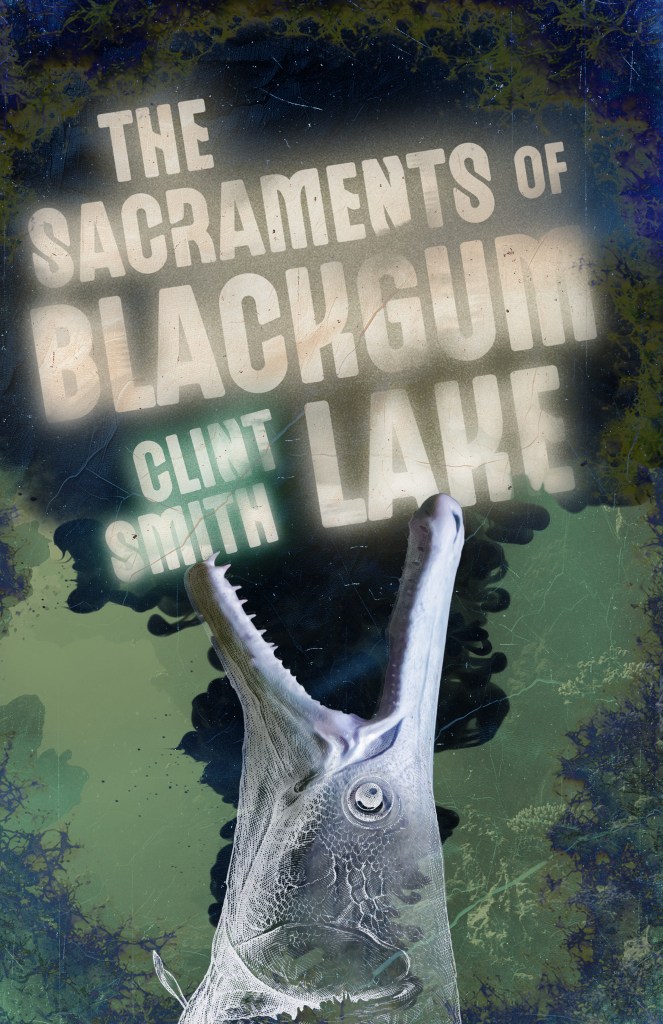
Coming January, 2026: The Sacraments of Blackgum Lake (Lethe Press)

It’s early on in the process, but I’m antsy.

With appreciation and pride, I’d like to announce that I’ve signed a contract with Lethe Press, which is set to publish my novella, The Sacraments of Blackgum Lake, in January, 2026. I’ve been working to distill this story since the summer of 2021, and am gratified that it’s found a home with such a reputable publisher. 

Above: Shortnose Gar (Lepisosteus Platostomus)

Set in the early 1990s, the narrative recounts a son and father dedicating a few summer months to renovating the family cabin. But it’s not quite that straightforward. I pitched the novella as a suturing between Carpenter’s The Thing, McCammon’s Boy’s Life, and Mann’s Public Enemies, and it’s been a worthwhile exercise ensuring those complicated stitches make sense.

Stone the Crow: A Review of Gordon B. White’s ROOKFIELD

Within Rookfield’s novella-length dimensions (Trepidatio Publishing, October, 2021), Gordon B. White achieves a narratively tight tale, while simultaneously managing to flex the story’s scope into something much more significant.  I was privileged to read this in galley form, and the story — from its vivid surface illustrations to its upsetting subtext — continues to haunt me. 

Clearly in touch with its scale, in terms of both tale and “the confines” of Rookfield itself, White swiftly establishes tension by sending his protagonist, Cabot Howard, in pursuit of his young son, Porter, who’s mother has made the unsanctioned call to escort the boy to the titular town.  I might mention, too, that these aforementioned confines are also beholden to the zeitgeisty component of a pandemic.  

Howard is a difficult character, making his presence in the ostensibly inhospitable Rookfield even more claustrophobic.  “A tornado wouldn’t be so bad,” Howard muses at one point, before “briefly entertaining the possibility of a whirlwind wiping him and the rest of the town completely away”; White proceeds:  “Only one lingering suspicion kept [Howard] from fully embracing the fancy, though:  If Rookfield was the real world, what worse Oz might a funnel cloud take him to?”

As Howard begins interacting with the town’s inhabitants, White initiates some Hitchcockian tension spooled with a Cohen Brothers’ brand of dark humor.  (An indelible cast of characters comes in White’s presentation of mysterious, “plague-doctor children.”  I’m particularly fond of one of these Pall Mall-packing children who receives some extenuated and entertaining stage time.)

Yet, despite Howard’s (sympathetic) pretensions, much of the action is saturated in his progressive scene-by-scene quest for his son, and how these set-pieces alter his initially inflexible character; and alteration, as it happens, possesses uncanny implications in the province of Rookfield.

With Rookfield, Gordon B. White cleverly corkscrews narrative threads, culminating in a compelling, claustrophobic nest of a novella, its final wings flaps remaining with me these many months later, seething with unsettling insinuation.