I have it on dependable authority that Gordon B. White maintains a daily regimen of long-hand writing exercises (you might glimpse a mention of this practice by way of some of his social-media posts). It’s a presumption, but I can’t help but consider that this pen-to-paper practice (diurnal journaling not being a unique task for many writers, though possibly an exhaustive disciplinary tactic to civilian sensibilities) has been a galvanizing ingredient in the syllable-by-syllable precision of White’s fiction.
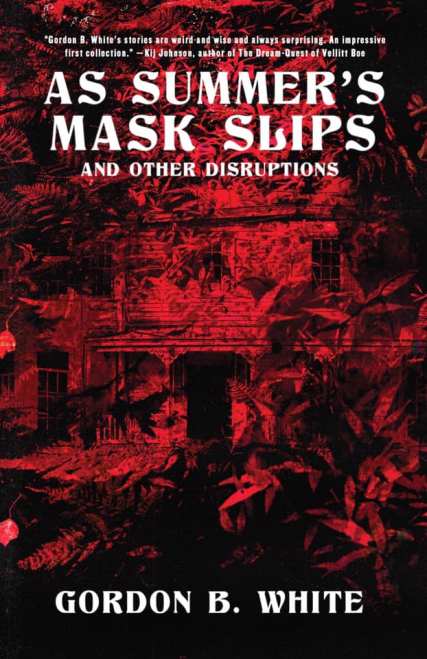
“Writing exercises are maps, not the destination,” writes novelist Bret Anthony Johnston. “They are the keys to the castle, not the castle itself.” As such, Gordon B. White reveals himself as both cartographer and locksmith in his debut collection, As Summer’s Mask Slips and Other Disruptions.

A coiling of quality and control, White’s collection houses a reverence for language and style, and showcases a devotion to the expansive spectrum of influence — a fictive continuum ranging from an intellectual, arthouse aesthetic to Creepshow escapism. White flexes enough of a scribbler’s muscle to make the collection, in its aggregate, subtlety instructive — pay attention to not only how he’s crafted the tales, but how (and perhaps his editorial collaborators) have elected to structure the collection.
The first half of the collection is threaded with themes of psychological precariousness and the necrotic logic of religious delusions; we abrade here too glimpses of deteriorative mental states and the gloomy aspects of domestic relationships.
The collection’s opener, “Hair Shirt Drag,” is a brief examination of social-sexual norms and a meditation on ritualized expectation — certainly, for our protagonist, but also for us as participants. A tale riddled with telegraphic pinpricks which act as an accretion for a final incantation: the story’s hue also functions as a reflection for White’s collection itself. “Words don’t mean nothing,” says the tale’s narrator. “It’s only intention that makes things happen.” White, however, is all too aware of the potency of words.
White’s initial acts also bear a sequence of shorter, flash-fiction pieces which successfully play like tonal interludes between stories (“But you were right. The Beast is coming”); likewise, further on readers will find “The Hollow,” a brief piece which works more like a well-defined sketch — a fermenting barm with all the characteristics of a fully-formed story eagerly waiting to be fed.
But by the second half, White quietly gives readers over to a series of more sober stories with an analysis of duality and the significance of altruistic paternality (which I’ll get back to in a few seconds).
Of note is “Open Fight Night at the Dirtbag Casino,” a poignant contemplation on the oxidizing qualities of revenge in the face of forfeited salvation. As short story collections are a useful tool for showcasing an array of creative capabilities, White demonstrates a variety of devices — on display here, a penchant for voice (“believe me, babies”) is shrewdly executed.

I can’t help but subjectively project the possibility that this tale was borne out of White’s laborious ethos when it comes to his craft. “I don’t have a way to keep track of how many times we’ve done this,” admits the narrator, and it’s interesting, in a macro sense, to wonder at White’s back-to-the-drawing-board awareness — which all writers resignedly confront — as he repeatedly slips on the skin of would-be short-story protagonists. “You’re never the same train hitting the same wall, the same straw on the camel’s back … [y]ou just gotta keep spinning, again and again, to see where it lands.” White’s violent piece concludes with a tenebrous and potent punch.
Opening, on the other hand, with a flurry of fistacuffs, is “Eight Affirmations For the Revolting Body, Confiscated From the Prisoners of Bunk 17.” Bound to a prison camp during an Us-versus-Them global war, the story hits satisfying dystopian notes while narratively balancing on razor-wire between horror and science-fiction. It’s scary and bleak, but closes on a bittersweet “note.”

But it’s “The Buchanan Boys Ride Again” that breaks the thematic fever of the first half of the book. A sort of salute to 80s horror and stitched with action-comedy quips, my main nit is a lack of clarity in the “creature” component’s explanation, the story, in commendable capacity, suffers from the same symptom as “The Hollow”: the skeletal system clearly urges expansion.

“The Buchanan Boys” is infused with enjoyable humor, but the underpinning preoccupation is clear and quite touching: the (ostensibly mundane) magnitude of fathers.
And while readers will glean as much in the closing sequences of stories, the collection’s dedication page is succinctly poignant. “For my father James — a teller of tales and gone too soon.” Gone, yes, but White has ensured that the man’s presence, and influential legacy, reverently resonates on our page.
Aided by a sluicing first-person execution, and imbued with themes of duality, loss, responsibility, the reflective “Birds of Passage” stands as the collection’s closer. “As I myself grow older, I often think back to that night on the river. About how there’s a world around us, but beyond us, too. A world that takes things, changes them, but sometimes gives them back. All of it — all of it is ripples.”
The catchy cadences of Gordon B. White’s prose serve as stepping stones for readers crossing the pleasantly deceptive arteries of his disquieting narratives. As Summer’s Mask Slips and Other Disruptions is an impressive exercise in precision, and a celebration of the unsettling.


