As I intend to record my sentiments with a genuine sense of heart-sick accuracy, the following thoughts will likely resonate with haste and, in a damning turn, I’m uncertain I’ll manage to edit these paragraphs in the way they deserve. Though, to honor my mentor, Jim, I’ll do my best to apply requisite revisions. I’ll do my best to make the time.

Jim Powell died on Monday January 27, 2020. He was sixty-nine years old. (You should read more here.)
One of the most formative discussions I had with Jim took place around 2011, not too long after the birth of my daughter. I was explaining a clumsy strategy for “making time” time to write, and that some of my tactics had downright devolved into schemes. Not necessarily lies for the obtainment of creative seclusion, but close enough. Whether political or artistic, Jim had a lot to say about liars and the varying shades of their taxonomic ranking.

I wrote about Jim Powell last year, just after the release of Only Witness, his collection of short stories which coincided with the 40th anniversary of the Indiana Writers Center— an organization Powell founded in 1979. That said, I’m not aiming for redundancy. Rather, I’m focusing on celebrating the lessons he’s left me with. Because make no mistake: He’s still teaching.
#
I wouldn’t necessarily describe it as a “daydream” (probably more of a delusion at this point in my career), but harbor an optimistic reverie related to a scene in Brian De Palma’s 1987 film, The Untouchables. (For the record, I’m not particularly enamored with the film. I’d chalk it up to an overall tonal strangeness—a mishmash dissonance between gangster severity and David Mamet’s commentary on camp.)

Despite a few memorable moments, my favorite scene finds Costner’s Eliot Ness in the midst of collecting his crew; he and warhorse Jim Malone (Sean Connery) pursue a “rotten apple” crack-shot at the police academy. They discover George Stone, the unassuming alias of Giuseppe Petri (Andy Garcia). After Malone intentionally provokes Stone into admitting his identity—“Oh please don’t waste my time with that bullshit,” says Malone—the veteran shoves a clipboard into the rookie’s chest. Weapons are drawn in an impulsive face-off, and with the silver barrel of a revolver touching his throat, Malone reveals a wry grin. “Oh I like him.” Jim Malone extends a hand to George Stone. “You just joined the treasury department, son.”
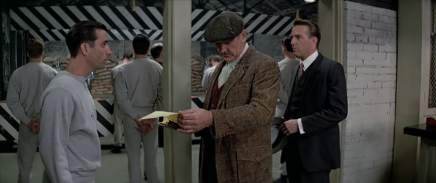
Jim Powell was the Jim Malone that saved my literary life. And although I sense that there will never be a grizzled, old-pro to extract me from my vocational low points—that help, essentially, is never coming—the daydream elicits a momentary mental smirk on bad days. And like many dreams it does, in many ways, sustain me.
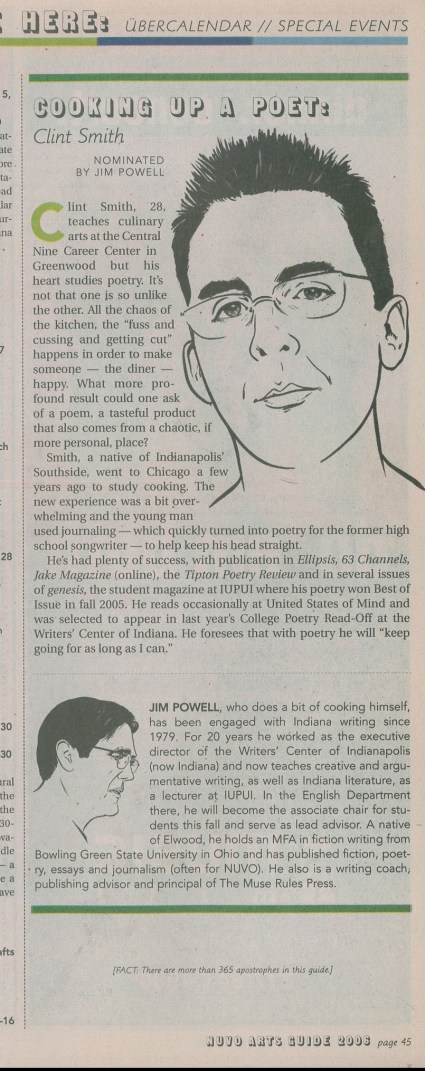
Annual NUVO Arts Guide (2006)
As my understanding of what Jim Powell actually did on IUPUI’s campus (and across the state and insulative Midwest, for that matter) matured as did my sobriety for what the device of writing was actually meant.
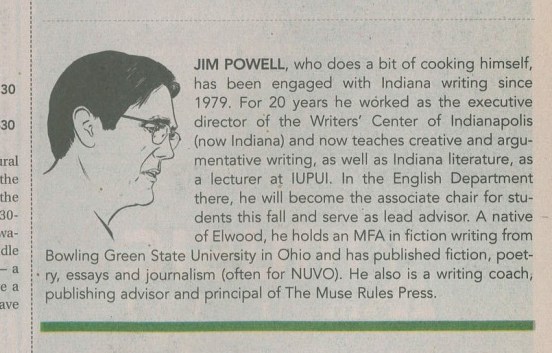
Annual NUVO Arts Guide (2006)
To be clear, I was no crack-shot, and in those early days of trying to understand what it meant to be a student worth his time and attention, Jim adhered to not only a high standard of production, but demonstrated a high standard of reciprocity: If you worked hard, he’d work just as hard for you—but, damn it, you had to put in the earnest energy. Don’t waste my time with that bullshit. As I began to demonstrate more discipline (not just academically and creatively, but personally — the three were, for a short time, parallels), Jim rewarded these bouts of growth with providing not necessarily flimsy encouragements, but something more valuable: A sense of identity. For me, in those nascent days, Jim Powell’s presence was akin to Jim Malone’s, though with a slight variation: You just joined the English department, son.
#
I won’t invest too many lines dwelling on grief (these things often have an unpredictable lag time). Besides, I can picture Jim bristling at any undue baroqueness, wincing, shaking his head, parted bangs wagging at his temples. I mean, we’ve been talking about this part of life, in one way or another, for years, no?
During the individualized guided-writing course (a class which occupied over twelve months under the sole guidance of Jim),
Though a separate essay could be born of memories orbiting the stories Jim assigned for deep reading over the years, one of my fondest is an examination of Kevin Moffett’s “Further Interpretations of Real-Life Events.” Originally appearing in McSweeney’s (2010), the story stages a narrator assessing not only his shortsightedness as both a writer and a son, but how the two might be simultaneously reconciled. In an orchestrated flex of desperation, the narrator—under the guise of a casual visit—pays his former English professor a visit with the hopes of validating his unproductive state as a writer, using the office as a confessional, of sorts; but the professor isn’t falling for it. “So what are you pretending to be today?” he says, nonchalantly dissecting the self-serving scheme. “I’m paid to teach students like you how to spoil paper,” the professor says; and when the narrator—unaware of his smug, intellectual preciousness—admits his writing’s hit a dead end, the elder says, “Well, I guess that’s how it goes. Talent realizes its limitations and gives up while incompetence keeps plugging away until it has a book. I’d take incompetence over talent in a street fight any day of the week.”
I’ve been guilty of this sort of simpering perfection and the desire for artistic verification, but Jim had seen too much, heard too many excuses, dismissed too many half-hearted confessions. Jim simply wouldn’t allow real writers to take the easy way out.

Release party, genesis, 2011
As Jim did with most all aspiring writers under his charge, he helped us break habits that would—both in the moment and, if they committed to the journey—result as artistic hindrances. Though we are, as fictioneers, liars by creative trade, he would also alert us to untenable bullshit: What was acceptable as art, what was lazy and insolent.
In 1977, Jim and a band of literary comrades opened a bookstore in Santa Monica, California, called Intellectuals and Liars. Jim is quoted as saying that they’re “two people you can’t trust”—an apropos description of both writers and poets.

Photo Courtesy of Karen Kovacik
Chekov comes to mind—more specifically, an excerpt from his story, “The Lady With the Pet Dog”:
He had two lives: an open one, seen and known by all who needed to know it, full of conventional truth and conventional falsehood, exactly like the lives of his friends and acquaintances; and another life that on in secret. And through some strange, perhaps accidental, combination of circumstances, everything that was of interest and importance to him, everything that was essential to him, everything about which he felt sincerely and did not deceive himself, everything that constituted the core of his life was going on concealed from others; while all that was false, the shell in which he hid to cover the truth … went on in the open. Judging others by himself, he did not believe what he saw, and always fancied that every man led his real, most interesting life under cover of secrecy as under cover of night.
As writers, we reveal ourselves in layers—yes, to our often limited audience, but this is also a mayday of sorts to the larger world. “The greatest benefit we owe the artist,” George Eliot suggested, “whether painter, poet, or novelist, is the extension of our sympathies … Art is the nearest thing to life; it is a mode of amplifying experience and extending our contact with our fellow-men beyond the bounds of our personal lot.” When we receive a response to theses cryptic signals, the world’s toothy machinations dull by a few degrees … contract a touch to become, if only for a time, more manageable. “The secret cannot be kept,” writes poet Jorie Graham, “It wants to cross over, it wants to be a lie.”

Tintern Abbey, Photo Courtesy of Karen Kovacik
And while the lies we tell ourselves are insidious, the lies we tell each other possess the potential for salvation.
#
“Anything worth saying is unsayable,” says the curmudgeonly mentor in Moffett’s story. “That’s why we tell stories.” In the beginning, I simply wanted to (graceless as it may have been) elbow my way for a place at Jim’s workshop table. In the middle, I wanted to be a good, literary soldier. And in the end, I somehow arrived at the undeserving luxury of calling him my friend.
Owing to its erratic architecture, the field of artistic creativity is one in which actual mentors are difficult to maintain. Some of this has to do with the nature of perpetual (and sometimes divergent) growth, which makes kindred alignment difficult to maintain. Some artists are just selfish assholes who are resistant to investing time to another person’s craft. But I think it’s the notion of emulation (particularly in the formative phases) which is both necessary and deceptive.
We all require scaffolding to initial mimicry, but we’re often impersonating an aesthetic from a distant proximity. This becomes, ultimately, limiting.

Indians game, 2013
After completing my degree, Jim and I stayed in touch; and while I could cite a number of humorous missives, Jim was less interested in discussing craft than he was in assessing life. In 2013, shortly before he and his wife, Karen Kovacik (who I’m indebted for introducing me to Isaac Babel thirteen years) trekked to Saugatuck, Michigan for their fifth anniversary. We’d just attended an Indians baseball game with my stepson, Jack. “And it was great to just hang out with you, and not worry about ‘schooling’ … And I am delighted to think your personal life is quite on track—the most important thing. I’m sure we’ll come up with some future activities.”
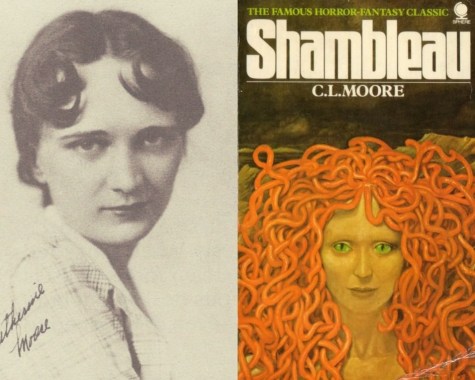
The last message I received from Jim was on January 24, and it was, of course, a note of guidance, directing my attention to Catherine Lucille (C.L.) Moore, a science fiction writer who attended Indiana University in 1929 (she went on to sell her first story to Weird Tales in 1933).
Ahead of making plans for his return to Indy, which would have been in close proximity to his birthday on February 19, I asked for Jim’s address down in Fort Myers. (He’d annually spent the winter months in Puerto Vallarta, Mexico, and was even working on a novel set in PV around 1916. “And, hey,” he wrote a few years ago, “it’s fine to drink margaritas en la manana here.”) He’d planned on being back in town around February 28. “Can’t receive mail here except through rental agent,” he wrote, “and that’s too difficult, so it will have to wait.”

“Big chill heading down from the north…”
Don’t second guess getting together for that Scotch with an old friend or snag a burger with a buddy. Resist the urge to assemble an excuse—because you’re too busy—to avoid playing an inane game with a child. Though the two are braided they are often exclusive, so while there exists the scattered workbench of art, there remains the craft of life. “I’m happy to think I’ve become my ‘best person’ in the last few years,” Jim said a few months ago. “I take great joy in seeing your happy family.”
No more excuses. You have to make the time.
#
The world, in macro sense, is replete with bad men. On a smaller, day-to-day scale, our world is filled with feckless men. Being a writer helps you calibrate your judge of character.
On my part, I’ll never be able to write like Jim, never be able to imitate his intellectual perception or his knack for subtext; but more importantly, there are other traits I’ll never be able to emulate. His patience, for instance. His compassion.
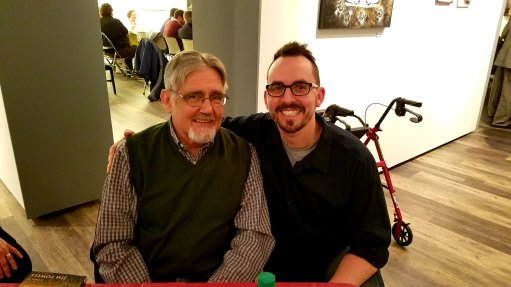
Only Witness Release Party, 2019
Great men die twice, wrote Paul Valéry—once as men and once as great. And even though he repeatedly warned against the solitary vagaries inevitable to a life dedicated to this craft, Jim—Jim’s guidance—made this existence as a writer, and made the world itself, a little less lonely.


 Clint Smith Fiction