As it relates to my personal (and somewhat erratic) habits of writerly creativity, the first few weeks of June, 2020, have been a time when reality, and rightfully so, has been too tangible for the folly of fiction. With pervasively observable pain too palpable for self-indulgent promotion, I found myself temporarily losing the taste for zany, self-indulgent make-‘em-ups. I continue to accept this difficult and socially-sobering period for what it is: an acute time to connect and listen.
Even as I write this, I sense that un-artistic logic to be flawed, as fiction itself operates like a mobius strip with reality. This particular, pivotal period calls for a vicious variety of verisimilitude.
#
I intentionally delayed promoting this, though it deserves both a mention and a cordial note of gratitude to Laird Barron. In an interview by Marshal Zeringue, posted June 1, 2020 on the Campaign For the American Reader site, Barron shared the following:
I also recently finished The Skeleton Melodies by Clint Smith. This collection of horror and weird fiction stories nicely ups the game from his 2014 debut, Ghouljaw and Other Stories. A resident of the U.S., Smith nonetheless has a gift for language and story that reminds me of my favorite weird fiction authors across the pond, namely Conrad Williams, Frank Duffy, and Joel Lane. The Skeleton Melodies is good work in its own right, however I admit to a trace of nostalgia. Smith’s affable and easy tone changes on a dime; monsters lurk in the shadows. He writes pulp of a literary sensibility that I relished in 1980s anthologies by editors such as David Hartwell and Karl Edward Wagner.
Last week, Hippocampus Press afforded a preview of two cover-art proofs of The Skeleton Melodies from Dan Sauer Design; and true to Sauer’s reputable form, the proofs are phenomenal.
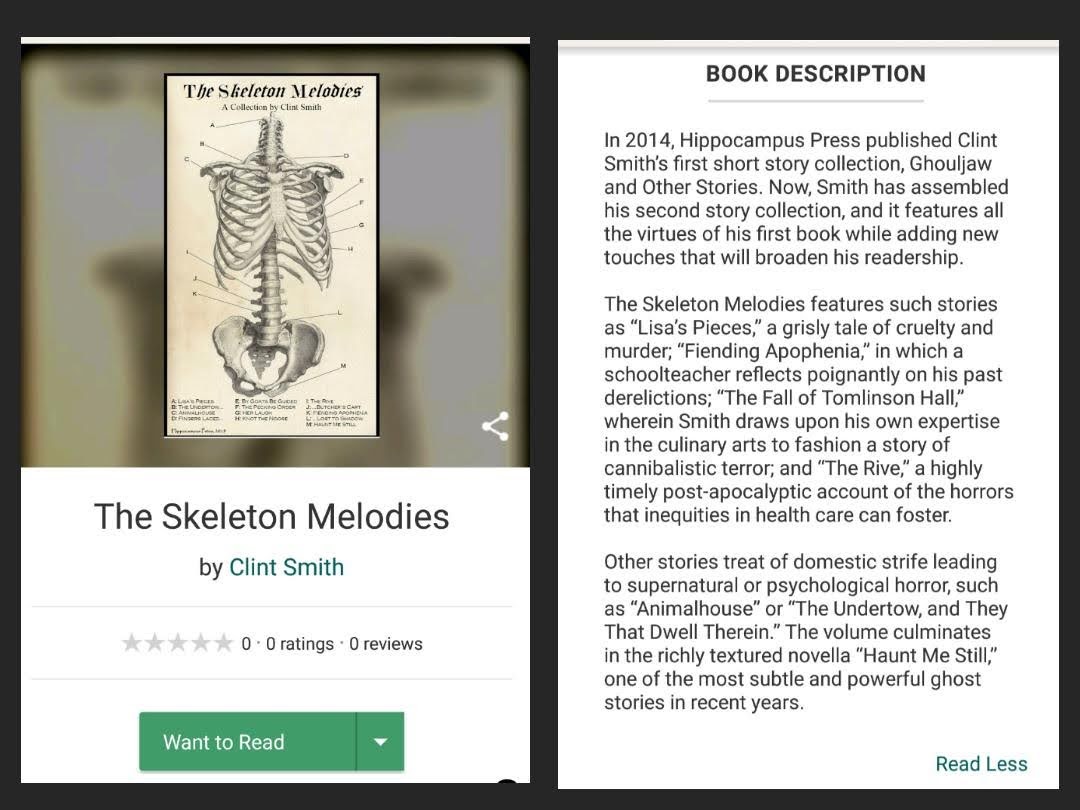
Also, The Skeleton Melodies now has a dedicated Goodreads page with the collection’s description (I’m unaware of who penned the overview pictured above, but am grateful for it):
In 2014, Hippocampus Press published Clint Smith’s first short story collection, Ghouljaw and Other Stories. Now, Smith has assembled his second story collection, and it features all the virtues of his first book while adding new touches that will broaden his readership.
The Skeleton Melodies features such stories as “Lisa’s Pieces,” a grisly tale of cruelty and murder; “Fiending Apophenia,” in which a schoolteacher reflects poignantly on his past derelictions; “The Fall of Tomlinson Hall,” wherein Smith draws upon his own expertise in the culinary arts to fashion a story of cannibalistic terror; and “The Rive,” a highly timely post-apocalyptic account of the horrors that inequities in health care can foster.
Other stories treat of domestic strife leading to supernatural or psychological horror, such as “Animalhouse” or “The Undertow, and They That Dwell Therein.” The volume culminates in the richly textured novella “Haunt Me Still,” one of the most subtle and powerful ghost stories in recent years.
If you’ve read an advanced copy, please visit the Goodreads page and share your thoughts.
 Clint Smith Fiction