DEAD RECKONINGS: #35, Spring 2024

Heads up, readers of horror and the weird: Now available via Hippocampus Press, the Spring, 2024 issue of Dead Reckonings. Edited by Alex Houstoun and Michael J. Abolafia, there’s a ton of coverage in this installment, including reviews on the works of Brian Evenson (None of You Shall Be Spared), Allison V. Harding (“The Underbody”), Clemente Palma (Malevolent Tales and Malignant Stories), and my colleague David Peak provides insight into Simon Strantzas’s Only the Living are Lost.

My contribution is a review of Adam Golaski’s latest short-story collection, Stone Gods (No Press). “Adam Golaski’s Stone Gods is a subversive distillation of literary dexterity and allegory,” I stated near its release, “both personal and universal.  By the time we notice one of life’s anomalies, readers will find that Golaski has already captured it, placed it under a cerebral bell jar, and altered his specimen into something both instructive and alchemically unconventional.”

Art by Anna MacLeod. Design by HR Hegnauer

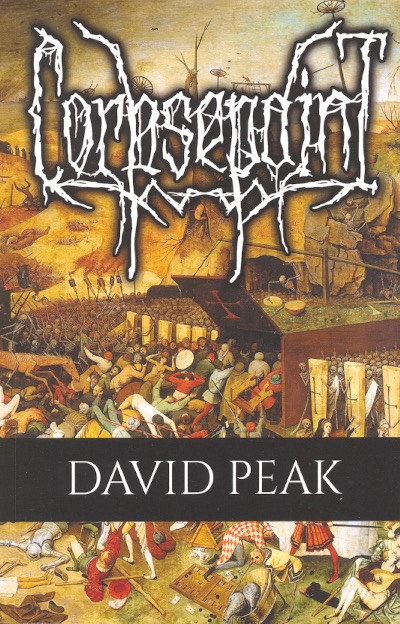
An Unforgiving Oblivion:  David Peak’s CORPSEPAINT (Word Horde, 2018)

There’s a dark identification in Corpsepaint (Worde Horde, 2018) on which Peak knowingly seizes, capitalizing on what exists in the often unmentioned dungeon of our conscience.  I’m a fan of Peak’s aesthetic, and the novel offers a bit of his range and impressive palette:  moments stripped bare while others hum with literary electricity.  An unforgiving piece of fiction that needs to be trusted in its execution and appreciated in its endurable scope.

Peak pleasingly name-drops the usual, classic- and Black-Metal suspects:  Bathory, Maniac, Judas Priest, Darkthrone, and throughout there are obvious nods to the infamous Mayhem (Peak even delivers a sly ball-breaker in the form of a “tech-death metal band in Indiana,” which, owing to my Midwest stomping grounds, elicited a grin).  In fact, Bathory’s indelible, 1988 album, Blood Fire Death, might serve as a succinct review for Peak’s novel by its title alone.

The novel, while bleak, was a swift read for me, owing mainly to Peak’s unforgiving urgency to extricate readers from comfy convention in exchange for the frigid, bloodlessness of primeval rumination and ancient instinct.  Corpsepaint ultimately operates like a ruthless gaze, one which, while cold, urges us, at first, to acknowledge the darkness, before turning our gaze in on ourselves.