Review: The Crafty Contagion of Frank Duffy’s DISTANT FREQUENCIES

It’s creatively unhealthy to covet the literary traits and fictive tricks of a fellow scribe.  Right?  (I’m, like, asking for a friend.)  It’s my estimation that, as opposed to wholesale envy, there’s nothing wrong with my creative aspirations (I mean my friend’s aspirations) to emulate the stylistic proclivities on full display in Duffy’s latest collection, Distant Frequencies (Demain Publishing, 2020).
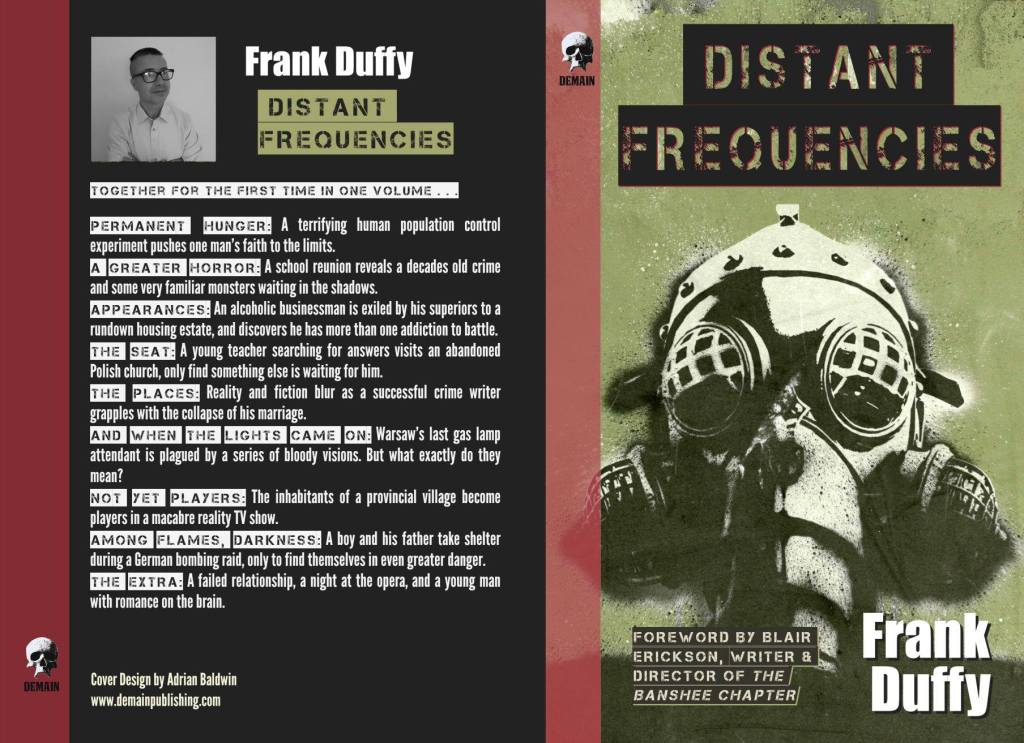
Among other crafty endeavors, Duffy is involved (in numerous creative capacities) with filmmaking (some of the lingo in the eerie, “Not Yet Players,” offers a tell-tale signal), and his proximity with the medium is reflected in his fiction.  There’s a cinematic precision in his stories that eclipses the typical tale which strives for a “ready-made” transfer to the screen — narratives which are all veneer and of little substantive distinction.  Instead, Duffy (and the effect possesses an effortless resonance) manufactures a brand of fiction wired-up with value and vividity.
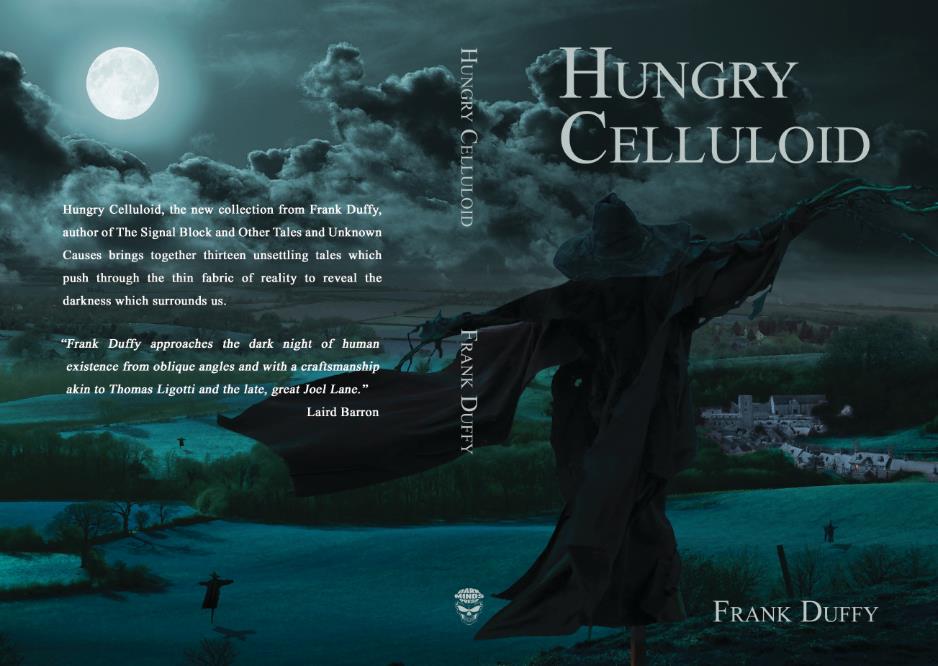
I’ve said it elsewhere but it bears repeating:  Duffy’s third collection of short stories, 2015’s Hungry Celluloid (Dark Minds Press), was an aesthetic inspiration.  Four years later, what continues to fascinate me (and my aforementioned friend) is Duffy’s ability to bring such descriptive electricity to such narratively-tight exercises.  There’s an inky dexterity to the nine stories in Distant Frequencies, demonstrating Duffy’s flexibility in a duality that is both literally “serious” and escapist in its capacity for outright horror.

There’s a deceptive breadth to Duffy’s stories that works to insulate readers as they proceed.  To put that strange sentence another way, it is — from the writer’s purview — about a selfless proficiency in your craft (functional fluency, in other words); and, from the reader’s perspective, a concern of intrinsic trust that the experience will consequentially satisfying.

Less akin to outright repetition, there are piercing pinpoints — the perpetual presence of the Priest, the black vestments, the unsettling-sentient hillside church, the rotting sanctuaries — which puncture and secure the stories with gleaming stingers.

Notwithstanding the extremities of your taste, it’s implausible that you’ll suppress a shudder throughout passages in the more eloquently eerie and acutely gruesome stories:  “A Greater Horror”; “Appearances”; “And When The Lights Came On”; and “Permanent Hunger.”

As I’ve said:  Ostensibly effortlessly, Duffy employs descriptions that are familiar in particular prism, while possessing the effect of lingering — in this, it becomes difficult to not see things his way long after you’ve parted ways from his stories:  His shadow games are now your shadows.  “The villagers stood beneath a tree, the upper boughs displaying a dozen corpses on ropes … black tendrils caught on a breeze.  The corpses blew back and forth, reanimated by the suddenly changing season.”  Yeah — that’s yours now too.  Let’s call it a contagion.  Crafty, for sure — deftly adept, without doubt — but a contagion nonetheless.
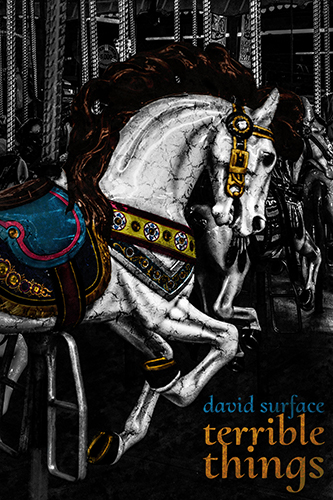
Enduring the Indelible: A Review of David Surface’s Collection, TERRIBLE THINGS

perf6.000x9.000.indd

It is quite possible that David Surface has experienced terrible things, but it is just as likely that he has helped, or offered comfort to, those who’ve not only witnessed terrible things, but learned to endure.  “The things we do to each other that seem so big and terrible at the time don’t really matter that much in the end” — this coming from Surface’s unsettling, “Writings Found In a Red Notebook,” a story where names and mere memories are talismans against an inevitable humanitarian deterioration.  “Not sure if that’s supposed to be a comforting thought or something else.”

surface2

While Surface’s work contains an incisive warmth, there is a soberly scientific calculation in his execution (it’s enjoyable observing how he provides predictive codes throughout his pieces).

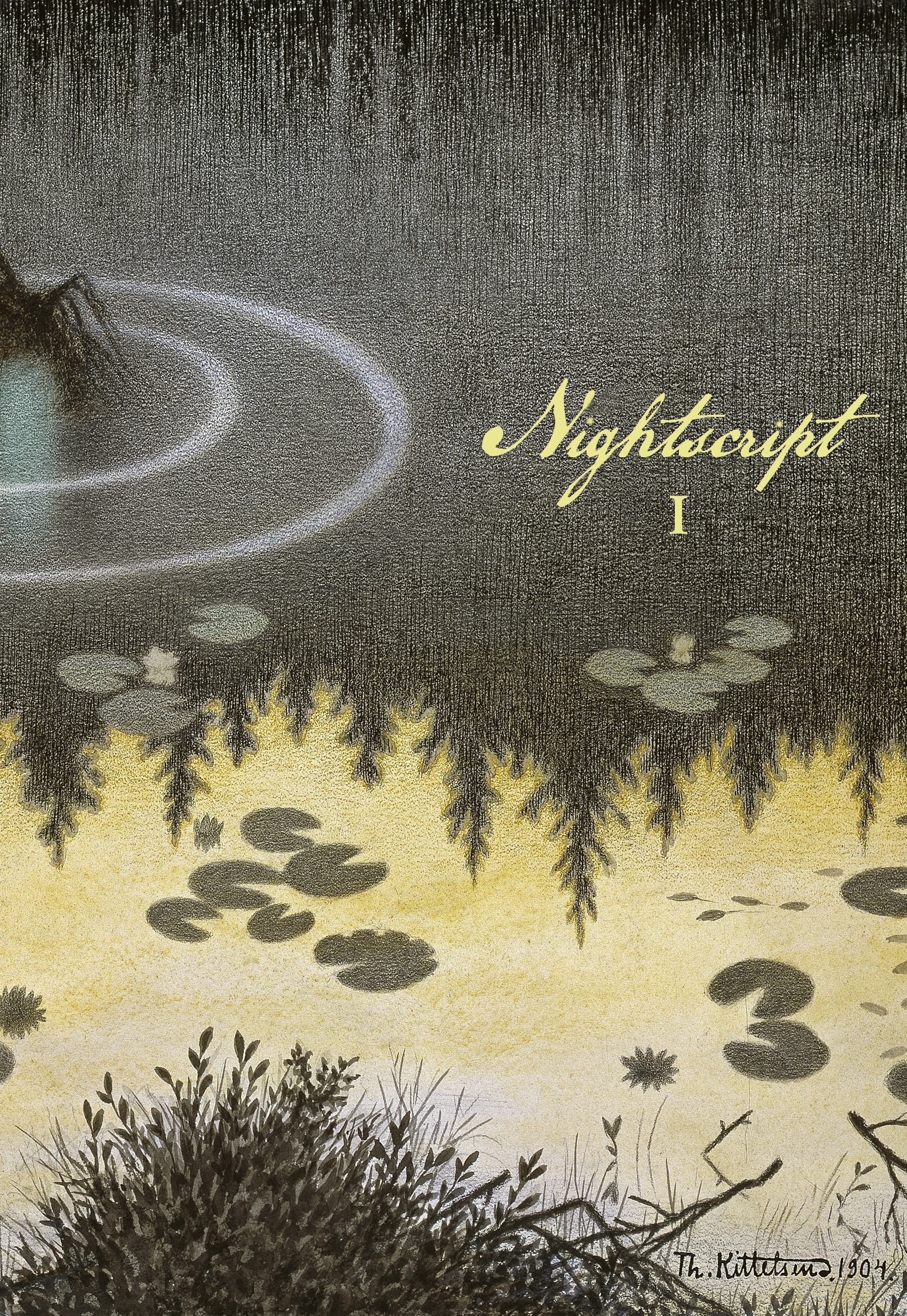
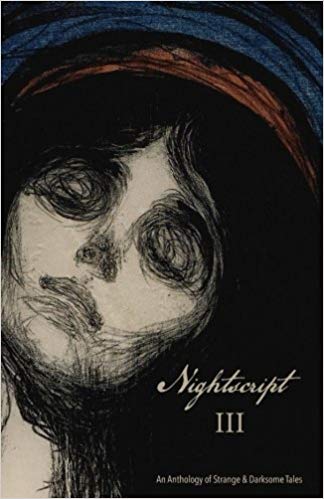
NightscriptI first confronted one of Surface’s stories five years ago, “The Sound That the World Makes” having appeared in the inaugural installment of C.M. Muller’s annual, autumnal exhibition, Nightscript.  Two years later in 2017, Surface provided “Something You Leave Behind” to the anthology’s third volume.  (Both stories appear in Surface’s collection.) In addition to demonstrating a deft handling of how details are meted out within a narrative, I now notice that the two stories contain thematic double-helices which twine much of Surface’s work — namely, how time affects the fickle nexus of friendship, and the vacillating reciprocity in our more intimate relationships; and while these ordinary topics might certainly be dismissed as too mundane for readers seeking the glee of gore, Surface’s goal, as a craftsman, eclipses gore.  In Surface’s stories, he trades sloppy shock value for an almost Hippocratic ethos to ease the pain incurred by indelible damage.  

n3As for the altering phases of relationships, we can examine a passage from that latter-referenced tale, “Something You Leave Behind,” the action centering on the unsteady union of spouses Janet and Jack.  “[Janet had] noticed it before, but tonight it seemed worse, like he’d aged overnight. For a moment she believed that if she passed him on the street, she wouldn’t recognize him” — this coming as Jack divulges an unexpected confession.  “‘You remember what you said, when I left? You’re not the same man I married.’ He paused and swallowed. ‘Those things I did, when I left. I used to wonder … how could I do that? How could I do those things to you? I tried to think, but there’s nothing there … like it was someone else who did those things.’”  When Janet attempts to alter tack, Jack’s agitation increases. “‘No,’ he said, his voice becoming more urgent. ‘I mean … what if it was?  What if it was someone else?’”  The story reveals then an uneasy revelation.

The varying dynamics along friendships’ timeline also factors heavily into Surface’s fiction — think of more ominous, atmospheric interactions in the vein of The Big Chill.  “Plans change — that was how Jerry put it,” comes a line in “The Sound the World Makes.”  “The important thing, he said, was not to be so attached to your plans for the future that you can’t handle it when a whole different future arrives.”

In “Last Ride of the Night,” Surface captures both the ramifications of shared wounds as he animates his characters quite literally down memory lane, fog-filled as it may be.  “I wanted the shock of contradiction,” his protagonist admits, “to have the flaws and falsehoods in my memory confirmed and held up to my face. I knew what I remembered and I wanted to be wrong.”

foggy1

The collection’s title story calls to mind moments from T.E.D. Klein’s, “Petey,” while framing the tale with both an “altered perspective” and an anthropological detachment in the analytical mode of more contemporary writers like Matt Cardin.

Yet it is in the story “Intruders” that distills not only Surface’s skill, but partially telegraphs his literary agenda.  In it, we have a teacher whose young charges are just beginning to confront the unpredictable realities of school-targeted violence.  Surface’s protagonist-teacher (I’ll avoid using the term “educator,” as it both limits and misses the point of what real teachers actually do) demonstrates the growing the claustrophobia of our increasingly violent climate, while delineating the tension of this occupation’s obligations:  the daily responsibility to maintain the safety of the vulnerable; the gravity of potential; and the ramifications of lost opportunity.  What is vigilance?, asks Surface.  What is overreaction? 

surface

It’s a compliment that the story calls to mind moments from Stephen King’s “Sometimes They Come Back,” though progresses beyond it in its all-embracing sympathies.  “Don’t lie to them,” comes a particularly haunting line from the story. “They’ll know.” It’s an instruction directed at both the students in his narrative and his audience facing the page.  David Surface is, even in his half-truths, being authentic.

#

Knowing very little of the man aside from the warmth and intellect reflected in his fiction — and how his aesthetic has affected me — I’ve come to gain a sense that Mr. Surface, as a writer, operates like a war-torn combat medic.  As the thirteen stories in his collection, Terrible Things deftly demonstrates, in the trauma unit of tale-telling, David Surface is unable to supply too many precious answers, rather he provides verbal sutures to the damaged and heart-sick, patching us up the best he can.

terrible things, layout