“He who has begun is half done…”

And while Mike and Lawrence and Kevin and Harlen and Cordie watched the satellite pass over, their faces raised in wonder at the bright new age now beginning, Dale watched them, thinking of his friend Duane and seeing things through the words that Duane might have used to describe them…

—Dan Simmons, Summer of Night (1991)

As I’m wont to do on Thanksgiving evening, as dusk draws up on a day dedicated to frantic culinary endeavors, a spectrum of logistics, and general familial demands (I’m grateful for the chaos and chores in all their variegated forms), I also nurture a memory, a narrow moment which had a profound consequences.

DS

That day and date back in November, 2000, represent coordinates of a tectonic shift along what was, at the time, a rather ambitiously listless landscape.  As I, along with many of you, express sentiments of, I also grow preoccupied by a sense of melancholy at closing that crease-covered paperback—a daunting melancholy (The amount of time and attention it must take to be a writer…) which was not wholly unpleasant, as it compelled the dissective questions:  How is it done?…How does this work?…How do you get them to see?

I began studying.  I began dissecting.  I began.  Sapere Aude—Incipe!

####

(November, 2017)

20171123_2147513492415209868696562.jpg

Seventeen years ago this evening, I stole away from an acidic / insipid Thanksgiving-dinner-table conversation, retreating to an isolated, second-story bedroom to read the last eight pages of the Warner Books paperback-version of SUMMER OF NIGHT. I scrutinized / savored the novel’s last lines with the understanding that I’d inadvertently navigated myself toward a craft-creative crossroads…

I’m still trying to figure out what kind of writer I’m supposed to be…


An Eloquent Undulation: C.M. Muller’s NIGHTSCRIPT, Vol. 4

N.4

Now in its fourth permutation, C.M. Muller’s Nightscript anthology continues to house — within its slate-scrubbed clapboard, concealed behind murky panes — a series of stories which, due to their strangeness and peculiarity, may have never otherwise discovered a proper home.
A shrewd student of a number of creative mediums, Muller is neither clumsy nor casual in his execution of these annual projects; and it really is a demonstrative exercise in voice and vision — his conjuring, capturing, and making incarnate (from font, to paper, in artwork, in tonality) a singular aesthetic.

Nightscript, IV expectedly contains a number of top-notch stories penned by (as Muller is wont to do) many “unknown” scribblers — this is one of the fantastic aspects of the series, as Muller places emerging names in close proximity with established writers, as is the case in N.IV with appearances by V.H. Leslie (“Sugar Daddy”) and Steve Rasnic Tem (“By the Sea”). I was personally taken with L.S. Johnson’s “A Harvest Fit For Monsters” (a grim and ambiguous tale of war-torn grief); Farah Rose Smith’s “Of Marble and Mud” (a crisply written narrative focusing on the frightening and fragile bond between two sisters); and Mike Weitz’s “Rainheads” (bearing bleak shades of apocalyptic horror).  Joanna Parypinski’s “The Thing In the Trees” is a personal highlight for me—one of the most haunting and deftly-handled tales I’ve encountered for quite some time.

Nightscript alumnus Charles Wilkison (“The Dandelion Disorder”) makes a welcome appearance, as well as Christi Nogle (“Cinnamon to Taste”) and Daniel Braum (“The Monkey Coat”). Resonating, still, for me are the stories “There Has Never Been Anyone Here” by J.T. Glover; “By The Sea” by the aforementioned Mr. Rasnic Tem; and Kirsty Logan’s “My House Is Out Where the Lights End,” which serves as the publication’s breathtaking, closing punctuation.

Another part of Muller’s magic is his sapient strategy in weaving an ambiguous melody in the sequencing of the tales, yielding a unique resonance and eloquent undulation to each installment.
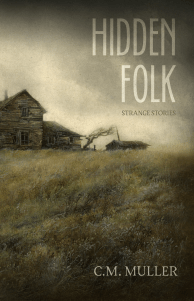
hidden-folk-cover

Nightscript is, of course, an annual celebration of the pleasant melancholies of autumn; but its contents are suitable for any timeframe in which a reader can carve out some solitudinal space, as the well-crafted tales call for your attention and close-reading consideration. More than this, Nightscript is — in Muller’s mental landscape — a vital venue for voices often lost beneath the wind-swept blanket of brittle, burnt-orange leaves — an otherwise unnoticed sibilance existing in the shadowed, foreboding fringes of a rickety-limbed forest.

Recently, Muller announced the forthcoming release of his first collection of tales, Hidden Folk. And if you’d like to get to know a bit more about this writer, editor, and self-described scrivener, check out an interview with Muller conducted by Scott Dwyer over the The Plutonian.